
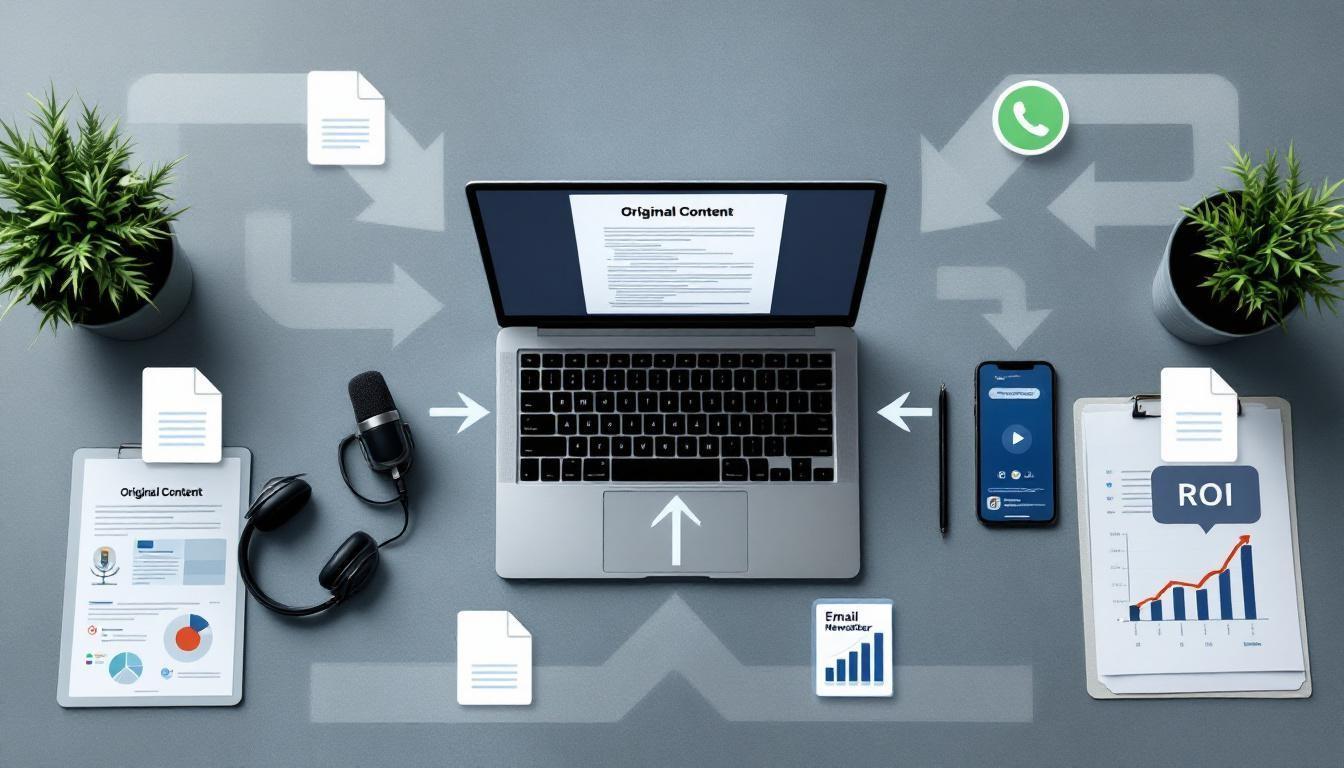
Most companies waste 60–70% of their content budget creating assets that get used once and forgotten. Content repurposing flips this equation by extracting multiple revenue streams from each piece you produce.
At Cajabra, LLC, we've seen firsthand how strategic repurposing cuts content costs while expanding reach across platforms. The data is clear: companies that repurpose content see 3x higher engagement rates than those starting from scratch every time.
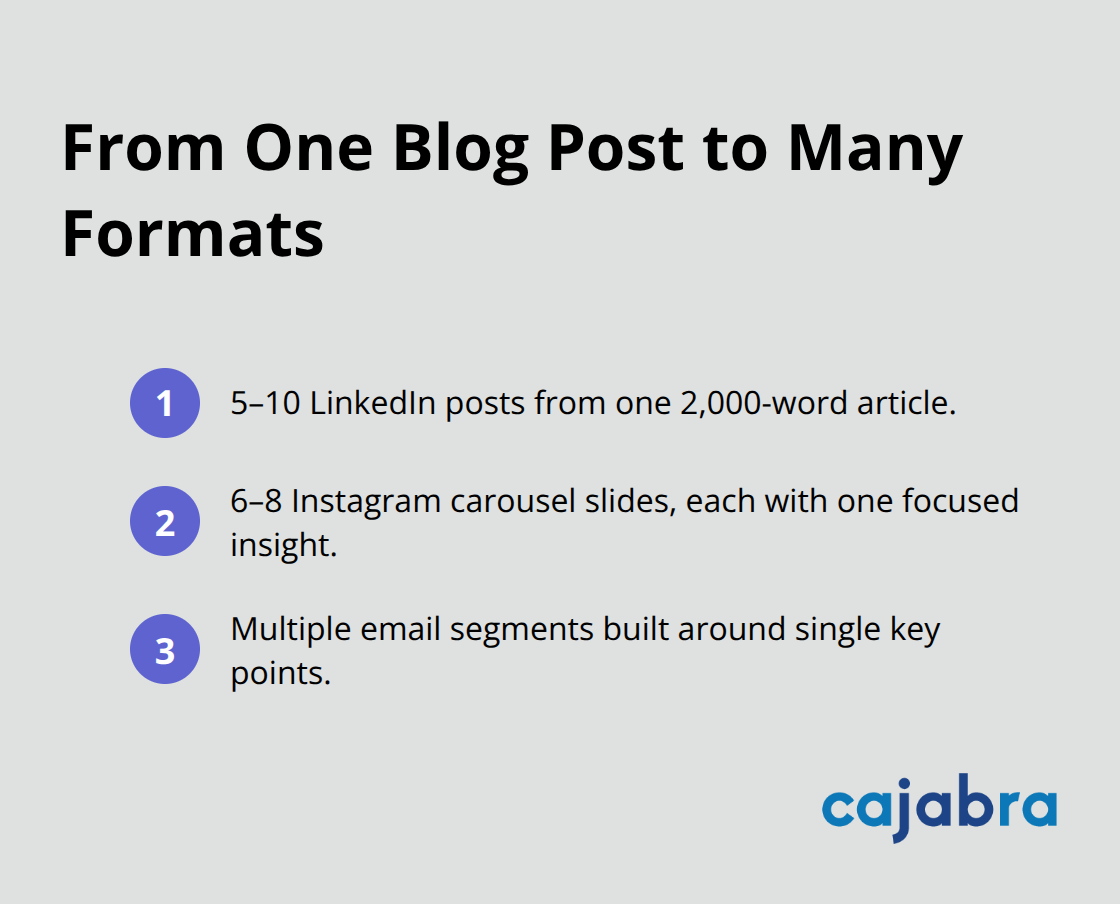
A single blog post that takes 8–10 hours to produce costs roughly $800–$1,200 in labor alone when you factor in research, writing, and editing. Most companies publish that piece once, watch it generate traffic for a few weeks, then move on to the next project. What they miss is that the same content can produce revenue across five or more channels without proportional increases in cost. A 2,000-word blog post, for example, yields 5–10 LinkedIn posts, 6–8 Instagram carousel slides, and multiple email segments, each focused on a single key insight. You extract modular value from work already completed rather than duplicating effort.
According to HubSpot research, repurposing content doubles engagement rates compared to relying solely on original assets. That's not incremental improvement-that's a fundamental shift in how your content performs.
Content creation budgets are finite. Most teams face pressure to produce more without additional headcount, which forces a choice: create less frequently or lower quality. Repurposing eliminates this false choice. Transforming existing assets saves 60–80% of content creation time compared to starting from scratch for each platform. A 30-minute interview can become a magazine feature, an email series, multiple social posts, two radio spots, and a quote for your annual report-all from one conversation. Buffer reports that systematic repurposing expands reach by approximately 400% across new platforms, while another analysis shows that repurposed content produces up to 40% more leads than entirely new content. The financial math is straightforward: you distribute the creation cost across multiple revenue-producing assets instead of betting everything on a single channel.
Evergreen content-pieces about timeless principles, foundational strategies, or recurring problems-should never become disposable. These assets remain relevant for years, yet most companies publish them once and archive them. High-performing content deserves a second, third, and fourth life across different formats and audience segments. A webinar recording transforms into shorter tutorial videos for users seeking quick guidance, or converts into a podcast episode for listeners during commutes. Video transcripts become 2,500+ word blog posts that boost time-on-page metrics and SEO performance. Case studies distill into focused blog posts targeting specific conversion keywords. The longer your content works, the higher your return on that initial investment. Quarterly content audits identify pieces with engagement above 5% or 1,000+ monthly visits-your repurposing goldmines worth maximizing across channels.
Not all content deserves equal repurposing effort. Lead-generating assets such as blog posts, webinars, and case studies drive conversions and signups, making them prime candidates for multiple formats. Data-rich content yields the most modular assets: dozens of social posts, several blog articles, and multiple videos can emerge from one report. You should prioritize top-performing content with engagement above 5% or 1,000+ monthly visits for repurposing. Analytics platforms reveal which pieces attract traffic and hold reader attention. Once you identify these winners, the repurposing process becomes systematic rather than random, ensuring your effort targets assets that already prove their value.
The foundation for maximizing content ROI rests on understanding these economics. Once you recognize how much value sits dormant in your existing library, the next step involves selecting the right methods to unlock that potential across your specific channels and audience segments.
A 2,000-word blog post sitting in your archive represents wasted potential if it only lives on your blog. The real power emerges when you systematically extract multiple formats from that single piece, each tailored to how different audiences consume information. Start with your highest-performing blog posts-those with 1,000+ monthly visits or 5% engagement rates-and break them into modular components. Each section becomes a standalone social post. Each data point becomes a visual graphic. Each key insight becomes an email segment.
A blog post about accounting firm cash flow management yields five to ten LinkedIn posts when you extract one actionable tip per post, six to eight Instagram carousel slides with each slide focusing on a single step or statistic, and multiple email newsletter segments sent across consecutive weeks. This approach works because you're not repeating the same content-you're reframing it for platform-specific audiences. LinkedIn professionals respond to detailed advice and industry context. Instagram users want visual simplicity and quick wins. Email subscribers expect deeper dives and exclusive insights.
HubSpot research shows that repurposed content delivers double the engagement compared to original assets alone. The multiplication happens because each format reaches different people at different moments in their decision journey.
Research reports and datasets contain dozens of repurposing opportunities that most companies ignore. A single industry report with ten key findings becomes ten separate blog posts, each optimized for different search keywords and audience segments. That same report produces multiple infographics highlighting your most striking statistics, suitable for Pinterest or LinkedIn.
Data visualizations perform exceptionally well on social platforms. You can create short-form videos showing what your data reveals, breaking down complex findings into 60-second explanations. Webinar recordings transform into podcast episodes for audiences consuming content during commutes. Transcribe those webinars into 2,500+ word blog posts that rank for long-tail keywords and boost your time-on-page metrics.
The transcription approach works particularly well because you already have the audio and speaking points; the writing becomes an editing exercise rather than creation from zero. Ahrefs demonstrates this method by embedding videos within blog posts derived from transcripts, which increases reader engagement and time spent on page. Testimonials and case studies deserve similar treatment-extract quotes into social posts, compile multiple testimonials into a dedicated landing page, and distill a full case study into a focused blog post targeting specific conversion keywords your ideal clients actually search for.
Platform algorithms reward consistency and relevance, but they punish generic copy-paste approaches. What performs on LinkedIn fails on Twitter, and what works on Facebook misses the mark on TikTok. LinkedIn audiences expect professional context, detailed explanations, and thought leadership positioning-your posts should run 150–250 words with a clear point-of-view. Twitter and X demand brevity and hooks that stop the scroll within the first five words. Instagram carousel posts need visual hierarchy and one insight per slide. Email newsletters tolerate longer-form content because subscribers already chose to receive your messages.
Rather than copying identical text across platforms, adapt the core message to match each channel's culture and format. A single insight about tax planning becomes a detailed LinkedIn post with industry context, a punchy three-tweet thread on X, an Instagram carousel with visual examples, and an email segment with implementation steps. This targeted approach costs almost nothing extra once you have the source material, yet it dramatically increases the likelihood that your message lands with each specific audience.
Repurposing without platform optimization wastes the opportunity. The next chapter explores the specific tools and systems that automate this adaptation process, allowing you to scale your repurposing efforts without proportional increases in team size or budget.
Repurposing only works at scale when you stop treating it as a manual process. The gap between knowing you should repurpose content and actually executing it across five platforms comes down to tooling. Most teams lack a systematic way to distribute adapted content, track what performs where, and organize repurposing campaigns without chaos.
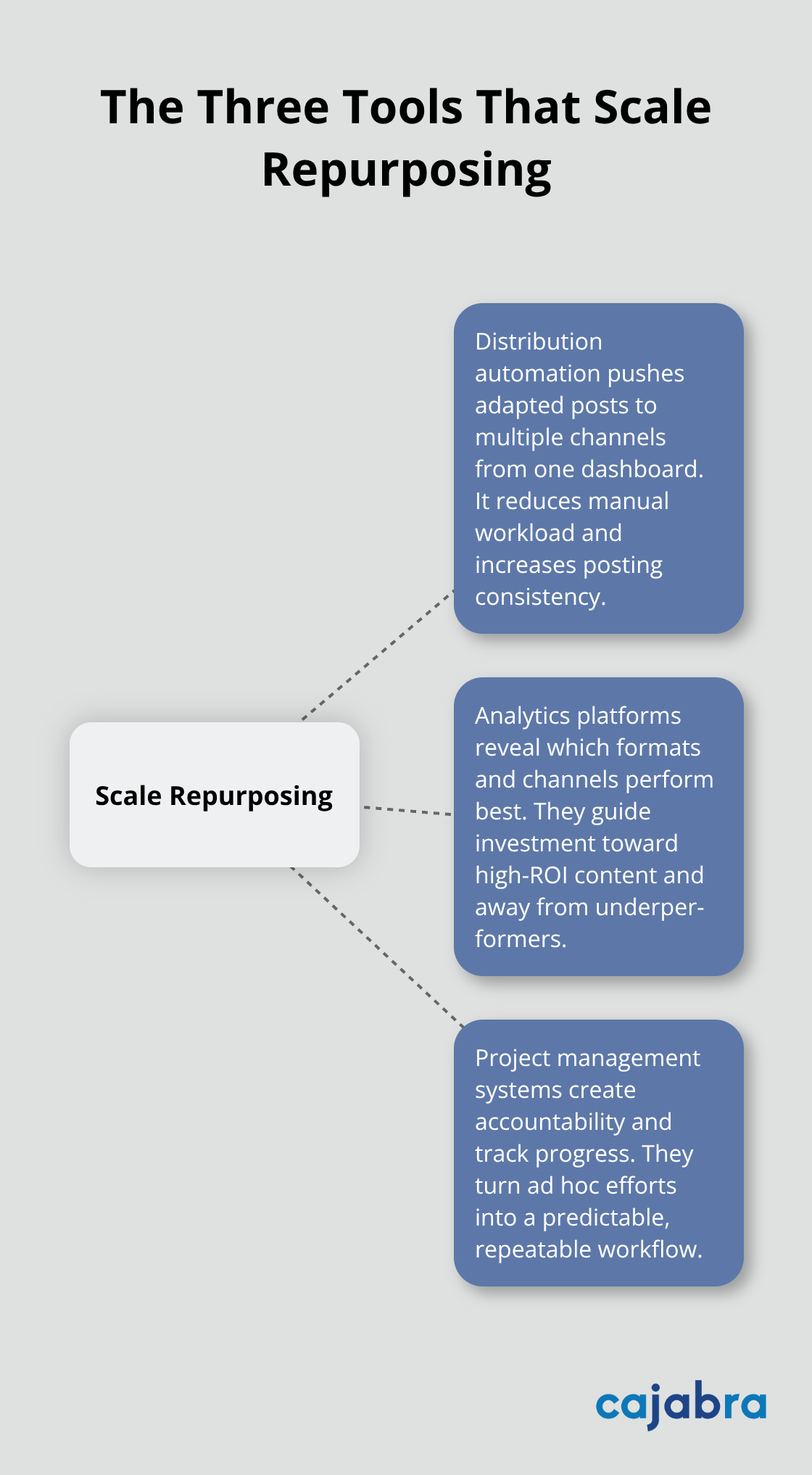
This gap is where good intentions die. You need three categories of tools working together: distribution automation that pushes content to multiple channels simultaneously, analytics platforms that show which repurposed formats drive actual results, and project management systems that keep repurposing campaigns organized across weeks and months. Without these, repurposing becomes another task piling onto already-stretched teams, and it gets abandoned within weeks.
Buffer, Later, and Hootsuite let you schedule repurposed content across multiple social platforms from a single dashboard. Instead of logging into LinkedIn, Twitter, Instagram, and Facebook separately, you write once and distribute to all channels on your preferred schedule. Distribution automation cuts your posting time by streamlining workflows across channels. Teams using scheduling tools post more frequently than those managing channels manually, which directly correlates with higher reach and engagement. This multiplication effect compounds over months as your content frequency increases without proportional increases in labor costs.
Google Analytics, platform-native dashboards, and tools like Semrush reveal which repurposed formats drive actual results. You need to know whether your Instagram carousel slides generate more engagement than your LinkedIn posts about the same topic, or whether email segments outperform social snippets. Without this visibility, you repurpose blindly and waste effort on underperforming formats. Analytics platforms reveal which repurposed formats actually drive traffic by tracking key performance indicators across channels. A quarterly audit of your top 10 repurposed pieces shows which formats deserve more investment and which ones you should abandon or redesign.
Monday.com, Asana, or Notion create accountability and visibility across your repurposing workflow. Map out your repurposing plan before starting: identify your source content, assign team members to specific format conversions, set deadlines, and track progress. A simple project template prevents repurposing work from getting lost in daily chaos. When your team knows exactly which blog post converts into what formats (and by whom and when), execution becomes predictable and repeatable rather than sporadic.
The combination of these three tool categories transforms repurposing from occasional effort into a repeatable system that compounds your content ROI over time. Distribution automation handles the logistics, analytics reveal what works, and project management keeps teams aligned. Together, they eliminate the friction that kills most repurposing initiatives before they gain momentum.
The numbers tell a clear story: companies that systematically repurpose content generate 40% more leads than those creating entirely new assets, while expanding reach by 400% across platforms without proportional budget increases. This isn't theoretical-it's measurable performance that directly impacts your bottom line. Analytics platforms reveal exactly which formats drive traffic, which ones convert, and which ones deserve more investment.
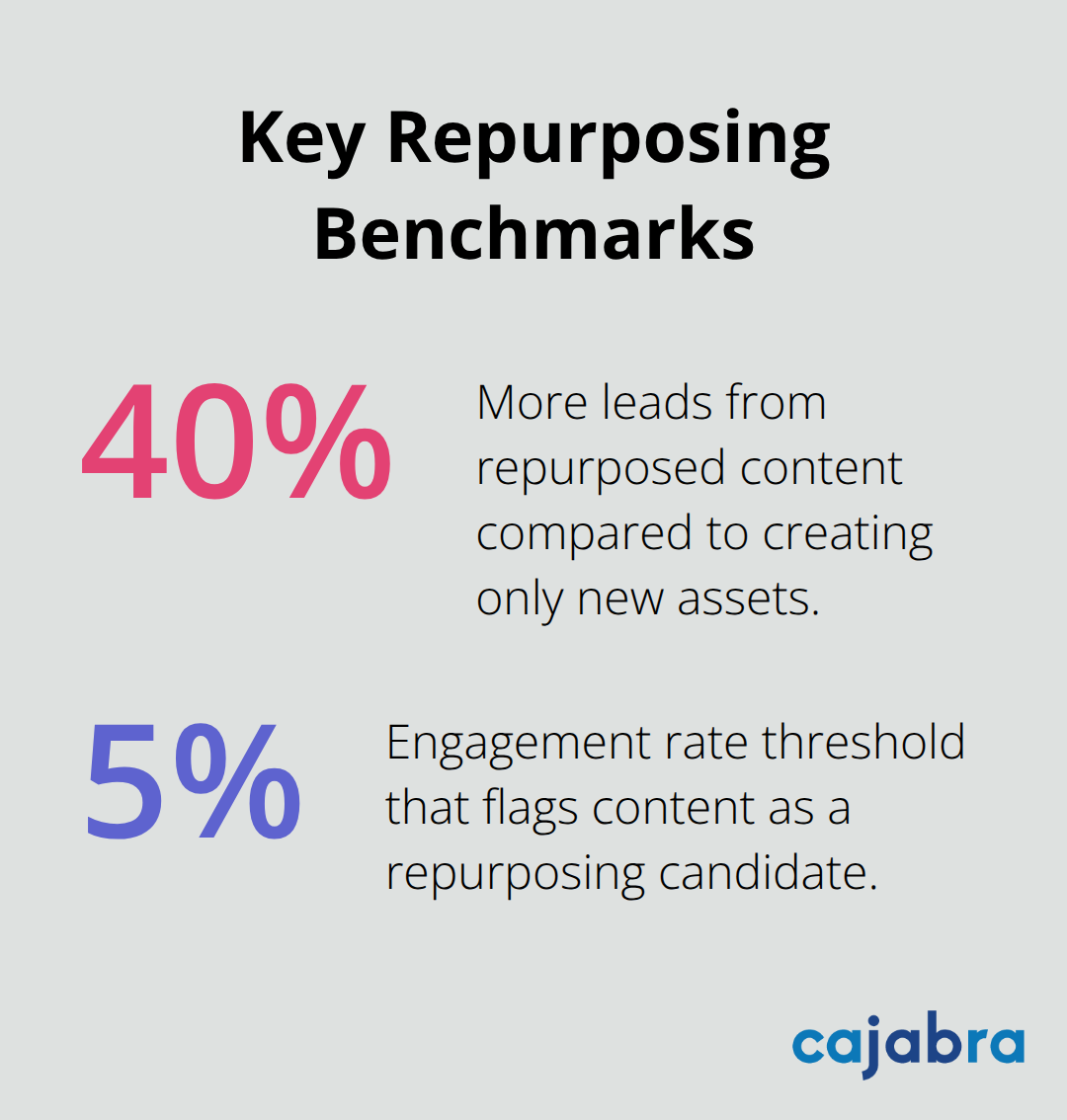
Start your content repurposing strategy with your existing winners: blog posts with 1,000+ monthly visits or 5% engagement rates that already demonstrate audience demand. A single high-performing piece yields five to ten LinkedIn posts, six to eight Instagram carousel slides, and multiple email segments, each tailored to its platform. This approach minimizes risk because you build on proven assets rather than experiment with untested material.
Distribution tools automate posting across channels, analytics reveal which formats perform best, and project management systems keep campaigns organized (without these three elements working together, repurposing becomes another abandoned task). We at Cajabra, LLC help accounting firms maximize their marketing impact through strategic systems that work smarter, not harder by securing retainer-based clients through effective positioning and lead generation. Your content library already contains the seeds of your next growth phase-content repurposing simply helps them flourish across every channel where your audience lives.