
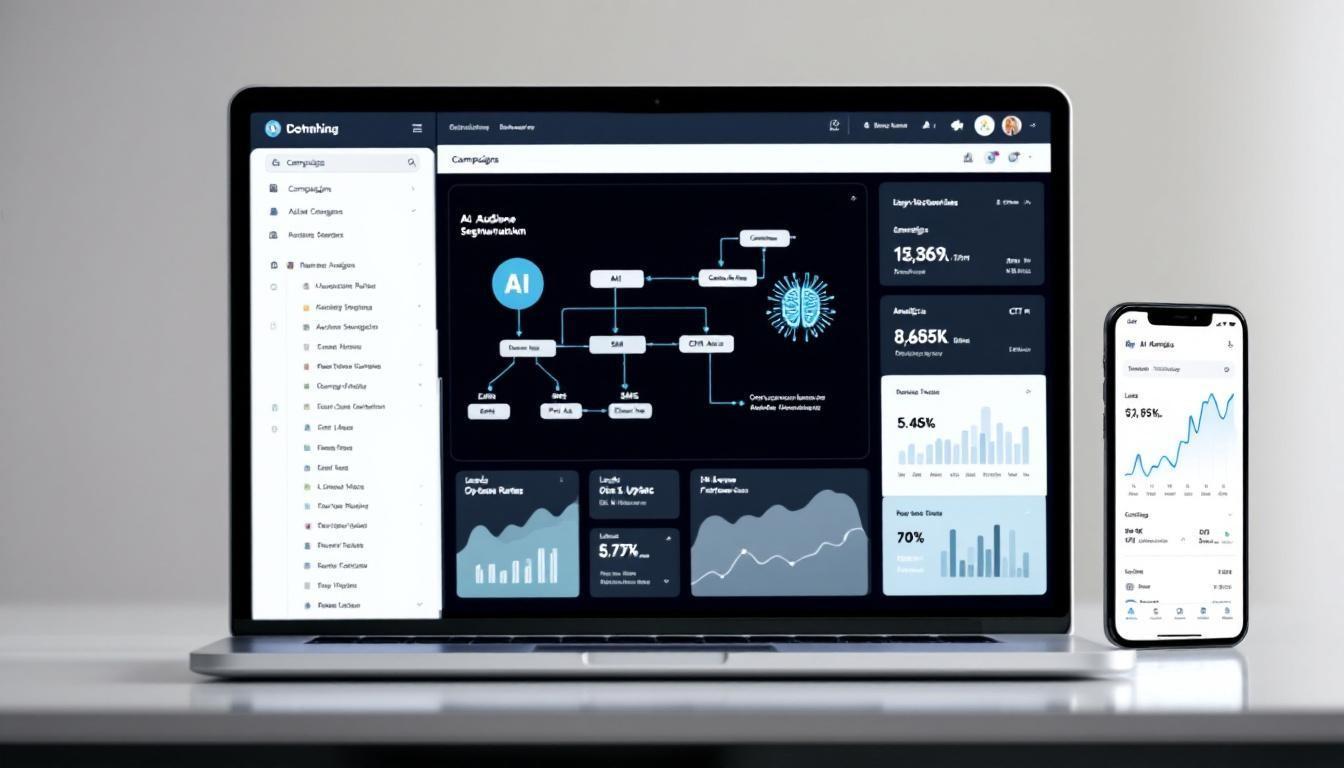
Accounting firms that ignore AI-powered marketing automation are losing clients to competitors who've already adopted it. The gap between firms using automation and those still managing campaigns manually has become impossible to ignore.
At Cajabra, LLC, we've seen firsthand how automation transforms client acquisition for accounting practices. This guide shows you exactly how to implement these systems and start seeing measurable results.
AI-powered marketing automation isn't just faster email scheduling or automated social posts. It's a fundamentally different approach to client acquisition that replaces rigid, rule-based workflows with systems that learn and adapt in real time. Traditional marketing automation executes the same sequence for every prospect-send email one on day one, email two on day three, regardless of whether they opened the first message or visited your pricing page. AI changes this entirely.
Instead of following predetermined paths, AI systems analyze individual behavior patterns and adjust messaging, timing, and channel selection for each prospect automatically. When a potential client visits your website, downloads a tax planning guide, and then views your audit services page three times in one week, the system recognizes buying signals that a static workflow would miss. AI-driven campaign optimization boosts performance, and real-time analytics enable automatic adjustments that shift budget toward higher-potential segments. For accounting firms specifically, this matters because your ideal clients-business owners with complex tax situations or growing companies needing audit services-have unpredictable research patterns. They might investigate your firm at 11 PM on a Tuesday, then go silent for two weeks. AI handles this variability; it doesn't care about your predetermined schedule.
Most accounting firms that claim to use marketing automation actually operate traditional platforms like HubSpot or Salesforce with basic triggers. These tools work fine for simple sequences, but they can't predict which prospects will convert, optimize email subject lines based on individual preferences, or reallocate budget from underperforming campaigns automatically. AI layers machine learning on top of these systems.
Salesforce research shows that 60% of high-performing marketing teams now use AI for campaign orchestration and journey mapping, while only about one-third of all organizations have moved beyond pilots to scale AI across operations. This creates a real competitive advantage for early adopters. When your firm implements predictive lead scoring-where AI assigns scores based on real-time signals rather than static criteria-your sales team spends time on prospects most likely to hire you. One mid-market SaaS firm shifted from static personas to AI-refreshed ideal client profiles and saw a 22% increase in pipeline velocity. For accounting practices, this translates directly to higher close rates and shorter sales cycles.
The accounting industry is consolidating. Larger firms with better technology capture market share from smaller and mid-size practices. If you're not automating client acquisition, you compete on price or reputation alone-both difficult positions. The firms winning right now combine first-party data (client information you own directly) with AI systems that identify patterns in who converts.
Coca-Cola using Adobe Experience Cloud achieved a 63% lift in click-through rates through AI-powered personalization. While your firm's scale differs, the principle remains identical: personalized, timely outreach converts better than generic campaigns. AI handles the personalization at scale. Without it, you manually segment prospects and create custom campaigns-work that consumes hours weekly and scales poorly. The sooner you implement these systems, the sooner your firm captures market share from competitors still managing campaigns manually.
Understanding how AI-powered automation works is one thing. Selecting the right tools and building workflows that actually drive client acquisition is another. The next section shows you exactly which systems fit accounting firms and how to set them up for immediate results.
AI-powered marketing automation generates qualified leads faster and with less manual work than traditional approaches. When you implement predictive lead scoring in your CRM, the system automatically ranks prospects based on real-time signals like website visits, email opens, content downloads, and service page views. Instead of your team manually reviewing prospect activity and guessing who's ready to talk, AI identifies hot prospects daily. A mid-market SaaS firm saw a 22% increase in pipeline velocity after switching to AI-refreshed ideal client profiles, and accounting firms experience similar gains because the system continuously learns which characteristics correlate with actual clients. For a firm generating fifty to one hundred leads monthly, this automation surfaces five to ten qualified prospects your team would otherwise miss.
Personalization at scale becomes possible without hiring additional staff. When a prospect visits your tax planning page twice and downloads your business entity guide, the system recognizes buying intent and adjusts the next email to address entity structure questions rather than sending generic firm overview content. AI-powered personalization through marketing automation delivers 30-50% higher conversion rates than traditional campaigns, and your firm's personalized outreach will convert at higher rates than one-size-fits-all campaigns. The system handles this customization automatically across hundreds of prospects simultaneously, something your team cannot replicate manually.
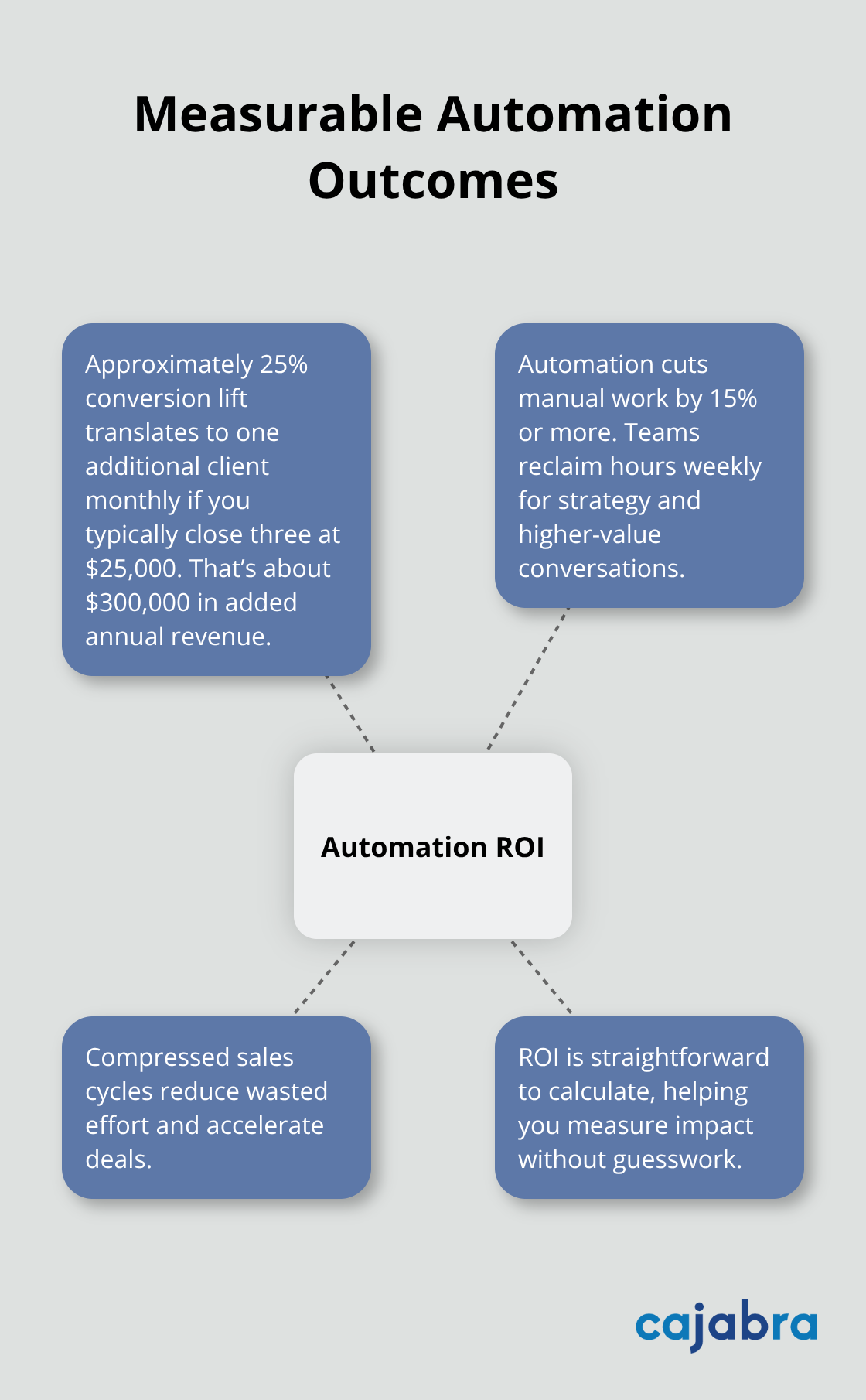
The ROI calculation is straightforward because automation compresses your sales cycle and reduces wasted effort. Firms report that AI-driven lead generation boosts conversion rates by approximately 25% while cutting manual work by 15% or more. If your firm closes three clients monthly at an average engagement value of twenty-five thousand dollars, a 25% conversion improvement means one additional client monthly, or three hundred thousand dollars annually. The time your team saves automating email sequences, social posting, and engagement tracking translates into hours weekly spent on strategy and higher-value client conversations instead.
Delta Air Lines attributed around thirty million dollars in ticket sales to real-time AI-driven optimization, demonstrating that continuous automated adjustments to campaigns drive measurable revenue. Your firm's scale differs, but the principle holds: automation that tests and optimizes email send times, subject lines, and content automatically will lift response rates and close rates simultaneously. Organizations investing 5% or more of marketing budgets in AI tend to see positive ROI, and most accounting firms allocate far less initially, meaning the upside is substantial.
The competitive advantage belongs to firms that capture these gains first because larger practices with automation technology will steadily acquire market share from those relying on manual processes. The accounting industry is consolidating, and firms without these systems fall behind. The next section shows you exactly which tools fit your firm's goals and how to build workflows that start generating qualified leads immediately.
Selecting the right platform determines whether your automation investment drives client acquisition or sits idle in your CRM. HubSpot AI works well for accounting firms under fifty employees because it bundles CRM, email automation, and basic AI features in one interface without requiring separate integrations. Salesforce Einstein targets larger practices with complex workflows and multiple departments, offering predictive lead scoring and journey analytics that adapt as your firm scales. ActiveCampaign and Marketo fall between these options, providing strong behavioral automation and segmentation for mid-size firms.
The mistake most accounting practices make is choosing based on feature lists rather than solving a specific problem first. Before you evaluate platforms, define exactly what you want to automate: Are you struggling to identify which prospects will actually hire you? Do you need to nurture leads through a longer sales cycle without manual touchpoints? Are you sending the same email sequence to every prospect regardless of their behavior? Your answer determines which tool fits.
HubSpot's predictive lead scoring works best if your primary pain is wasted sales time on unqualified prospects. Salesforce Einstein makes sense if you manage multiple client acquisition channels and need real-time budget optimization across them. Start with one specific outcome-such as surfacing five hot prospects weekly or reducing email sequence creation time by ten hours monthly-rather than trying to automate everything simultaneously.
Your workflow design directly determines whether automation generates results or wastes time. Start with a single high-impact use case that your team currently handles manually and costs real hours weekly. If your team spends four hours weekly reviewing prospect website visits and deciding who to contact, that becomes your pilot.
Build a workflow where AI flags prospects who visited your tax planning page twice within seven days and downloaded your business structure guide, then automatically sends a personalized email addressing their specific interest. Test this for two weeks, measure how many prospects respond, and track how many eventually become clients. A mid-market SaaS firm saw a 650% ROI by targeting AI-refreshed ideal client profiles, and accounting firms see similar gains because the system learns which signals actually predict conversions.
Once this workflow proves it generates qualified conversations, expand to a second use case like email send-time optimization or content personalization. Integration with your existing systems matters less than people assume-most modern platforms connect via Zapier or native integrations, and the workflow itself drives results, not the technology underneath. Many accounting firms already use HubSpot or Salesforce; adding AI capabilities to those systems beats replacing them entirely.
Set a weekly review cadence where you compare what the AI predicted to what actually happened, then specify three concrete changes for next week. This closed-loop process transforms AI from a black box into an operating system for growth. After four weeks of running the first workflow, you'll have real data showing whether the approach works for your firm, which removes guesswork from scaling.
Accounting firms that implement AI-powered marketing automation now will capture market share from competitors still managing campaigns manually. The gap widens monthly as larger practices deploy these systems and smaller firms fall further behind. Early adoption means converting more prospects into clients while your team spends less time on repetitive tasks.
Pick one workflow that currently consumes hours weekly-whether reviewing prospect activity, sending email sequences, or identifying qualified leads. Build that automation, run it for two weeks, and measure the results. A mid-market SaaS firm saw a 22% increase in pipeline velocity by switching to AI-refreshed ideal client profiles, and your accounting practice will see similar gains because the system learns which signals predict actual conversions.
We at Cajabra, LLC specialize in moving accounting firms from overlooked to overbooked through the JAB System™. Our approach combines AI-powered marketing strategies with automated systems that generate consistent cash flow, and we handle the marketing complexity so you focus on client service and your expertise.