

Your accounting firm's website needs to work flawlessly on phones and tablets. Over 60% of web traffic now comes from mobile devices, and Google ranks mobile-friendly sites higher in search results.
At Cajabra, LLC, we've seen firsthand how poor mobile optimization drives potential clients away. The good news is that fixing this problem delivers measurable results for your firm's growth.
Mobile devices now account for 63.31% of global web traffic as of March 2025, meaning more than six out of every ten visitors to your accounting firm's website arrive on a phone or tablet. This shift isn't gradual-it's the dominant reality.
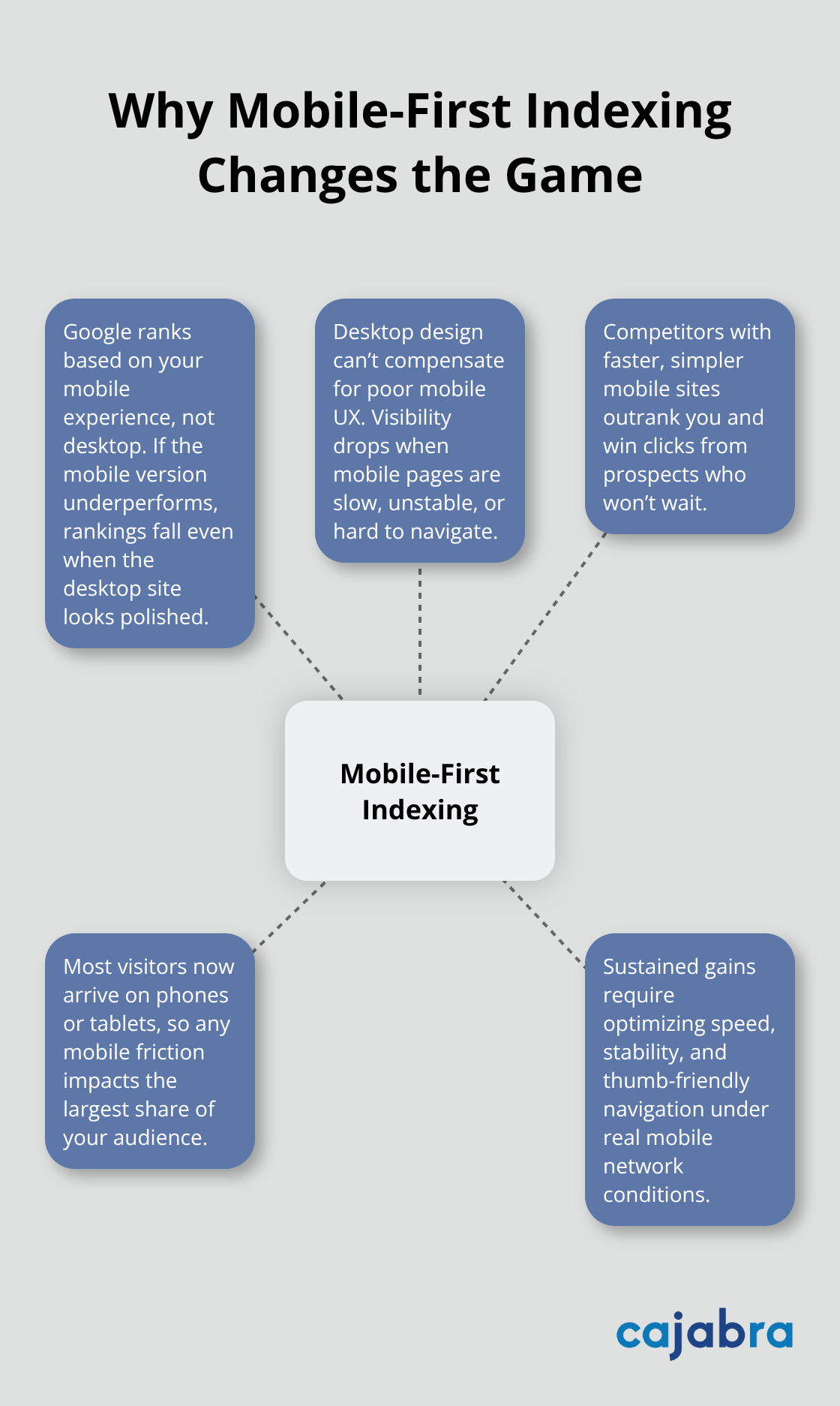
Google responded by making mobile-first indexing the standard for all sites, meaning the search engine crawls and ranks your site based on how it performs on mobile, not desktop. If your mobile experience lags, your visibility in search results drops regardless of how polished your desktop version looks. Accounting firms that ignore mobile optimization lose visibility to competitors who don't, and potential clients simply move on to firms with faster, easier-to-navigate mobile experiences.
More than 40% of users won't wait longer than two seconds for a page to load, according to the State of Mobile 2024 data. For accounting firms, this matters because initial consultations and engagement often happen on mobile. A prospect searching for tax advice or audit services on their phone expects instant results. If your site takes five or six seconds to load on a mobile network, they've already clicked to a competitor. Google's Core Web Vitals now directly affect rankings, with emphasis on LCP, CLS, and INP on real mobile networks. These aren't theoretical benchmarks-they're the performance standards Google uses to rank sites. Heavy third-party tools like CRM widgets, chat systems, and calendars add input lag on mobile devices, so you need to optimize these integrations aggressively.
GA4 data reveals that most new users arrive on mobile, and high-value events like inquiry submissions and initial consultations often start there. However, friction on mobile leads to faster drop-offs than on desktop. A cumbersome contact form, slow page loads, or confusing navigation on a phone causes prospects to abandon their search before completing an inquiry. For accounting firms, mobile optimization directly impacts lead generation. Responsive design that scales content intelligently for smaller screens keeps navigation simple and readable, reducing the friction that causes mobile visitors to leave.
Your site's mobile performance now determines both search visibility and conversion potential. The stakes are high: prospects expect content to appear instantly, interactions to feel fluid, and navigation to stay within thumb's reach. When your site meets these expectations, visitors stay longer and complete actions like scheduling consultations or requesting proposals. When it doesn't, they leave. Third-party integrations (CRMs, chat widgets, calendars, maps, personalization layers) can slow mobile performance significantly, so audit which tools you actually need and remove those that add unnecessary weight. Image optimization matters too-compress images aggressively to support faster loads on slower mobile networks.
The path forward requires more than a responsive template. Your accounting firm needs a mobile experience that supports how prospects actually make decisions today: on their phones, during lunch breaks, or while commuting. This means fast pages, stable layouts, lightweight scripts, and predictable interactions under real-world conditions. The next section covers the specific strategies that move your firm from a mobile-friendly website to a mobile-optimized conversion machine.
Google's ranking algorithm now prioritizes mobile performance as the primary factor determining search visibility. When a prospect searches for accounting services in your area, the firms appearing at the top of mobile search results are those with optimized mobile experiences. Mobile devices account for over 60% of global web traffic, which means mobile optimization directly affects both organic and paid search performance. If your site loads slowly on mobile or forces visitors to pinch and zoom to read content, Google pushes your firm lower in rankings while competitors with faster, cleaner mobile experiences climb higher. Mobile performance now determines whether prospects find your firm first or scroll past to competitors.
Accounting firms lose potential clients at the moment of decision when mobile experiences are poor. A prospect researching tax strategies or audit services on their phone expects to complete an inquiry form, schedule a consultation, or navigate to your contact information without frustration. Most new users arrive on mobile, and high-value events like inquiry submissions often begin there-but friction on mobile causes faster drop-offs than desktop. Forms that require excessive scrolling, fields that don't auto-format phone numbers correctly, or navigation menus that cover half the screen force mobile visitors to abandon their search. Accounting firms with cluttered mobile navigation experience significantly higher bounce rates than those with streamlined, thumb-friendly layouts. Every second a prospect spends struggling with your mobile site is a second they could spend contacting a competitor instead.
Mobile optimization directly affects whether prospects take action or leave. 70% of users say page speed influences their willingness to purchase professional services. For accounting firms, this translates to conversion rates. A site that loads in two seconds on mobile networks keeps prospects engaged long enough to complete an inquiry or request a proposal.
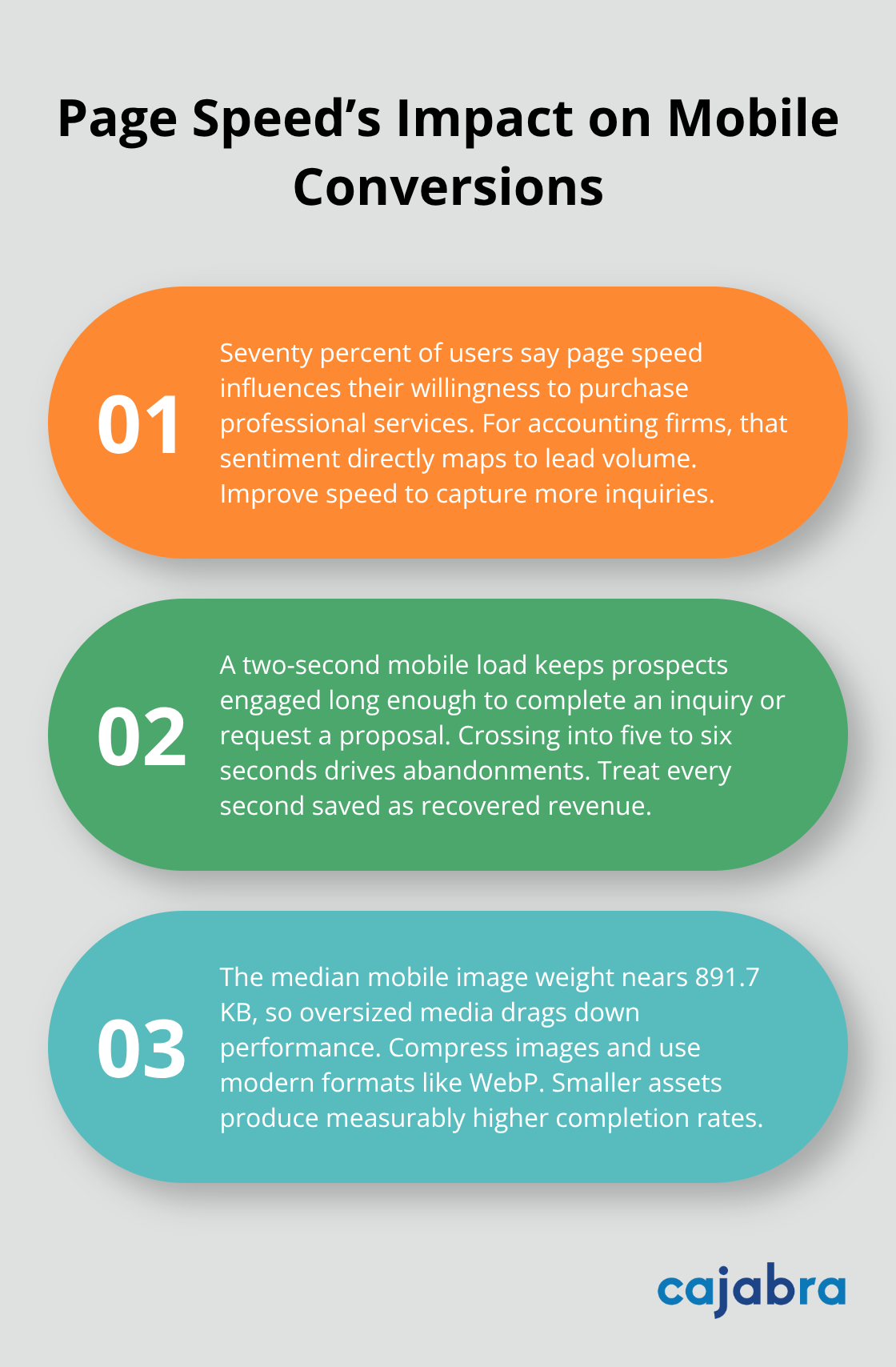
A site that takes six seconds loses them. The median mobile image size sits around 891.7 KB, so aggressive image compression matters-oversized hero images and unoptimized graphics tank page speed on slower mobile networks. Reducing unnecessary third-party tools and simplifying contact forms removes barriers between prospect interest and action. Accounting firms that treat mobile optimization as a conversion tool rather than a design afterthought see measurable increases in client inquiries and consultation bookings.
Page speed directly correlates with whether prospects complete actions on your site. Mobile visitors expect content to appear instantly and interactions to feel fluid-anything less causes them to leave. Heavy third-party integrations (CRMs, chat widgets, calendars, maps) add input lag on mobile devices, so audit which tools you actually need and remove those that add unnecessary weight. Image optimization matters equally; compress images aggressively to support faster loads on slower mobile networks. Prospects who experience fast, stable pages stay longer and complete actions like scheduling consultations or requesting proposals. Those who encounter delays abandon their search and contact competitors instead.
The path forward requires more than a responsive template. Your accounting firm needs a mobile experience that supports how prospects actually make decisions today: on their phones, during lunch breaks, or while commuting. This means fast pages, stable layouts, lightweight scripts, and predictable interactions under real-world conditions. Clear navigation and logical information architecture transform a fast, mobile-friendly site into one that converts prospects into clients. The next section covers the specific strategies that move your firm from a mobile-friendly website to a mobile-optimized conversion machine.
Responsive design is non-negotiable, but it's also table stakes-the bare minimum that separates professional firms from those stuck in 2015. A responsive site that scales content intelligently for mobile screens matters, but what actually drives conversions is aggressive optimization of the three factors that kill mobile performance: oversized images, unnecessary third-party tools, and bloated forms.
Start with image optimization. The median mobile image size runs around 898.8 KB, but accounting firm websites often load hero images and graphics that exceed 1.5 MB per image. Replace these with compressed versions under 800 KB, use modern formats like WebP for faster delivery, and lazy-load images below the fold so they don't slow initial page load. Test your compression with tools like Google PageSpeed Insights, which shows exactly how much load time you're wasting on oversized assets. Every megabyte you cut from your images translates directly to faster page loads on slower mobile networks.
Next, audit every third-party integration on your mobile site. CRM widgets, chat systems, calendars, maps, and personalization layers add input lag that makes interactions feel sluggish on real mobile networks. Most accounting firms load far more tools than they actually use. Remove chat widgets that get ignored, disable auto-loading calendars, and replace map embeds with simple address text and a link to Google Maps. Each tool you remove directly improves the speed prospects experience when they interact with your contact form or navigate your pages.
Forms present the biggest conversion killer on mobile. Accounting firms typically ask for too many fields, don't auto-format phone numbers, and force visitors to scroll endlessly through required information. Simplify your inquiry form to five fields maximum: name, phone, email, firm size, and service type. Auto-format phone numbers so visitors don't need to add dashes or parentheses. Place the submit button where visitors can reach it without scrolling. Use a single-column layout on mobile instead of multi-column designs that force pinching and zooming.
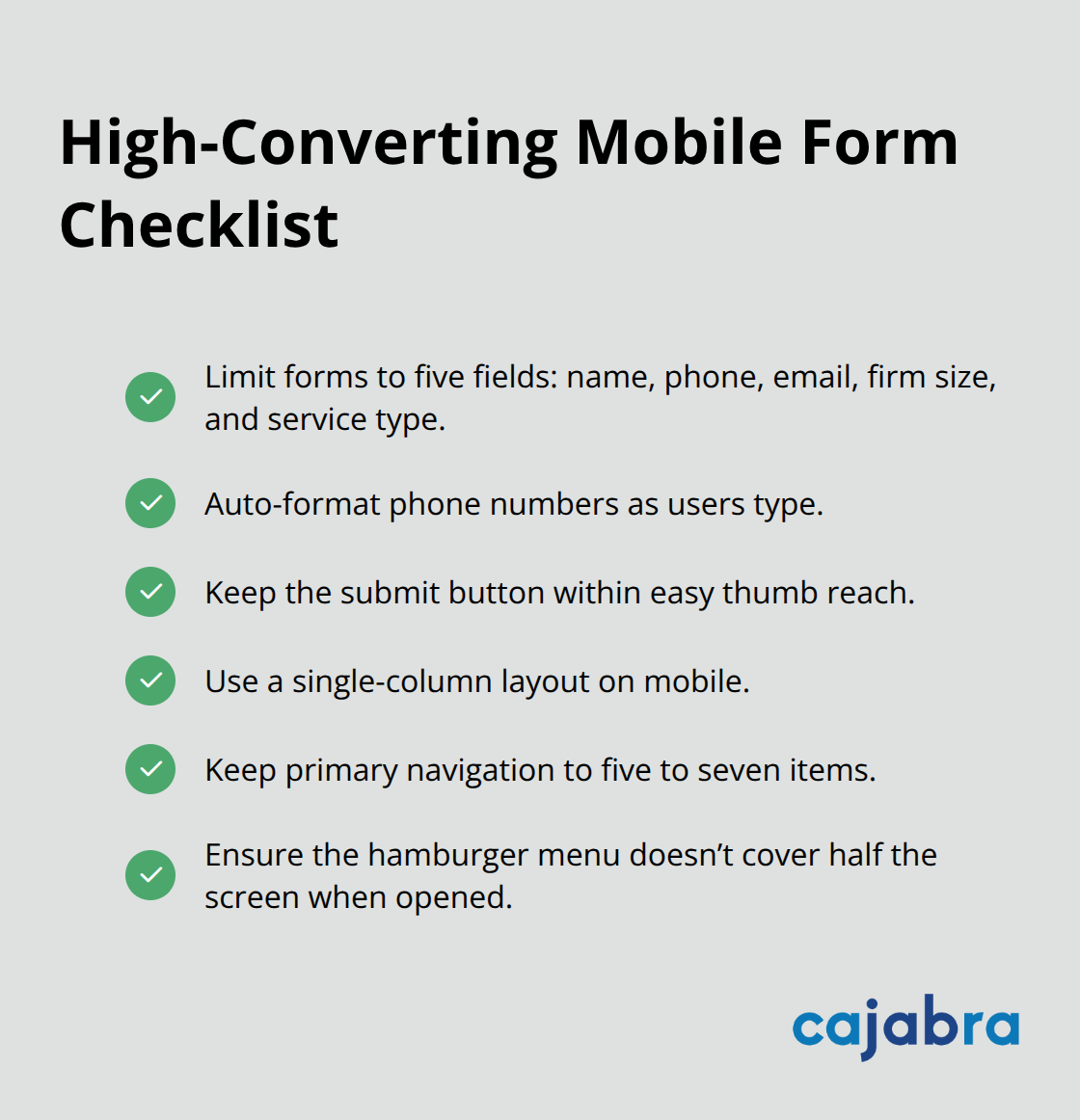
Navigation should occupy no more than five to seven primary items, with a clearly visible hamburger menu that doesn't cover half the screen when opened.
Test your mobile experience on real devices using Chrome's mobile emulator or tools like LambdaTest Real Device Cloud, not just your desktop browser. Load time on a real 4G mobile network differs dramatically from what you see on your office WiFi. Try for Core Web Vitals targets of LCP under 2.5 seconds, CLS under 0.1, and INP under 200 milliseconds on real mobile networks. These aren't arbitrary numbers-Google uses these exact metrics to rank sites and determine whether prospects stay or leave. Accounting firms that treat these optimizations as conversion priorities rather than design afterthoughts see measurable increases in inquiry submissions and consultation bookings.
Mobile-friendliness stopped being optional for accounting firms years ago. It now determines whether prospects find your firm, stay on your site, and take action. The data confirms this reality: 63.31% of web traffic comes from mobile devices, Google ranks mobile-optimized sites higher, and prospects abandon sites that load slowly or force awkward navigation on phones. Your competitors understand this shift, and the firms winning new clients treat mobile optimization as a conversion tool, not a design afterthought.
The real business impact shows up in your inquiry submissions and consultation bookings. When you compress oversized images, remove unnecessary third-party tools, and simplify your contact forms, prospects complete actions instead of leaving. A two-second page load keeps them engaged; a six-second load sends them to competitors. Every optimization you make directly affects whether your accounting firm captures leads or loses them to firms that prioritize mobile performance.
Start by testing your site on real mobile devices and checking your Core Web Vitals on actual 4G networks, not your office WiFi. Identify which third-party integrations drive value and which ones add unnecessary weight. Compress your images aggressively and simplify your forms to five fields maximum. If you want professional guidance on modernizing your website and optimizing your digital presence, Cajabra helps accounting firms build lead-generating websites that position your firm as an industry leader.