

Accountants who ignore SEO for accountants are leaving money on the table. Most potential clients search online when they need accounting services, and if your firm isn't visible in those results, competitors are capturing your leads.
At Cajabra, LLC, we've seen firsthand how the right SEO strategy transforms client acquisition for accounting practices. This guide walks you through the specific tactics that work.
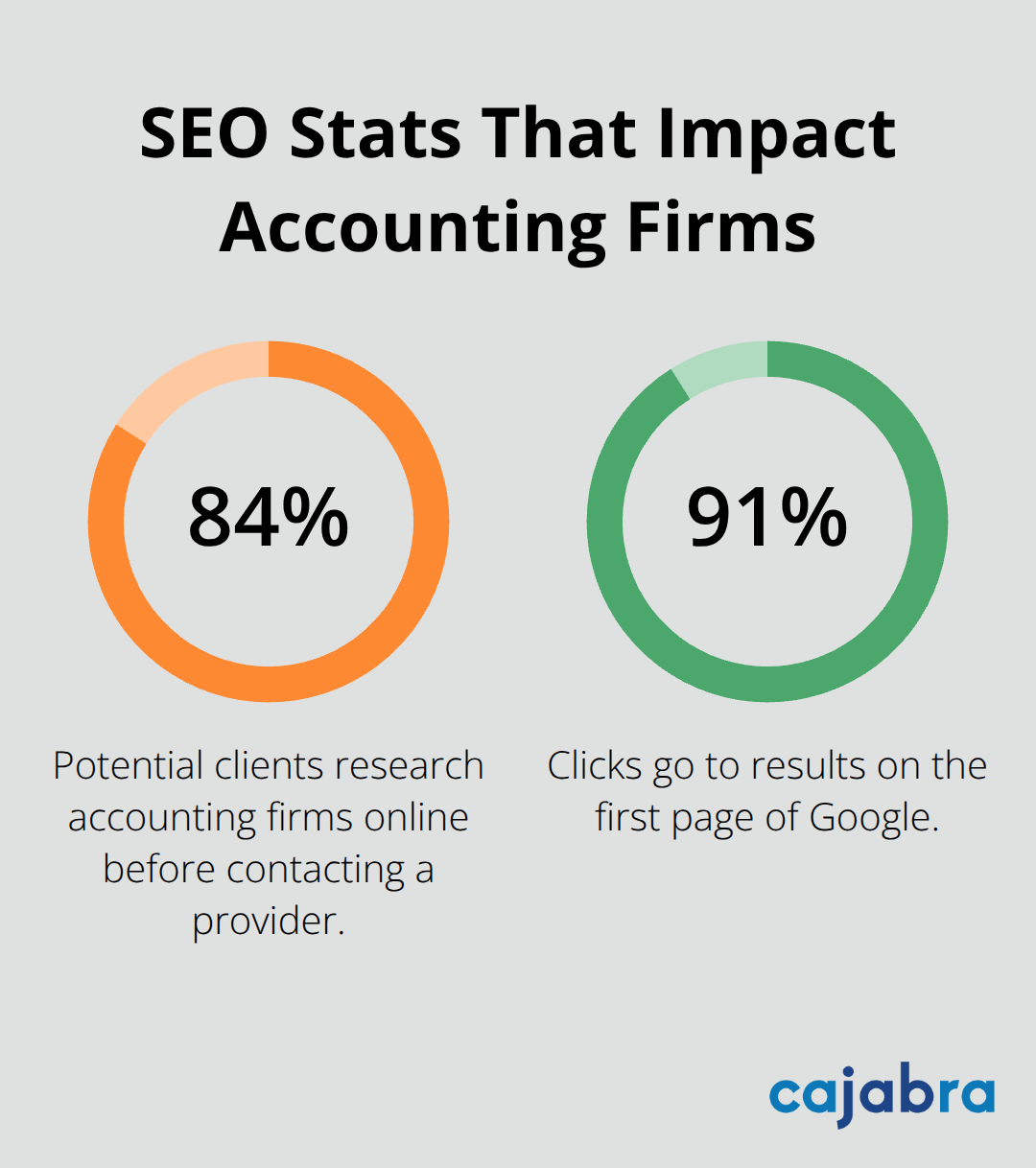
The numbers are impossible to ignore. 84% of potential clients research accounting firms online before making contact. That means the vast majority of people who need your services are already on Google, searching for help. If your firm doesn't appear in those results, you're not just missing visibility-you're actively losing revenue to competitors who do show up. Google processes over 8.5 billion searches daily, and accounting-related queries represent a significant portion of local business searches. When someone types "accountant near me" or "tax preparation services," they're ready to hire. They're not browsing casually. They need help now.
The problem is stark: 91% of all clicks go to results on the first page of Google. Ranking on page one is the difference between attracting clients and being invisible. Most accounting firms either ignore SEO entirely or treat it as an afterthought, which creates an opportunity for firms willing to invest in it properly.
Your ranking position directly determines how many potential clients find you. A firm ranking fifth for "CPA in Dallas" captures dramatically fewer leads than one ranking second. The difference between position one and position five on Google translates to thousands of lost inquiries annually for most accounting practices. This isn't theoretical-it's how Google's algorithm works. The platform prioritizes certain websites based on technical quality, content relevance, and authority signals. When you optimize for these factors, you move up. When you don't, competitors do.
Local SEO proves particularly powerful for accounting firms because most clients prefer working with someone nearby. They search with geographic intent, which means targeting location-based keywords like "bookkeeping services in [city]" or "small business accountant near me" puts you directly in front of your ideal market. Unlike paid advertising (which stops producing leads the moment you stop paying), organic search traffic compounds over time. A blog post you publish today that ranks in six months will continue bringing clients for years.
Not all website traffic matters equally. A visitor who searches for "how to become a CPA" is not a prospect. A visitor who searches for "tax preparation for LLC owners" or "payroll services for small businesses" actively looks for what you offer. This distinction separates effective SEO from wasted effort.
When you target high-intent keywords-phrases that indicate someone is ready to buy-your website attracts serious prospects instead of tire-kickers. These visitors convert at much higher rates because they're already sold on needing your service. They just need to find the right firm. This is why keyword research matters. Tools like Google Keyword Planner and Ahrefs help you identify what your actual prospects search for, not what sounds impressive.
The most effective accounting firms target niche, specific keywords rather than broad terms. "Tax deductions for real estate investors" attracts more qualified leads than just "tax deductions" because it speaks directly to a specific client segment. These qualified leads require less sales effort to convert into retainer clients because they've already self-selected as a match for your services. Once you understand what your prospects search for, you can build the technical foundation and content strategy that positions your firm in front of them.
Your website's technical health determines whether Google can even index your pages, let alone rank them. Most accounting firm websites fail on basics before they ever reach content strategy.
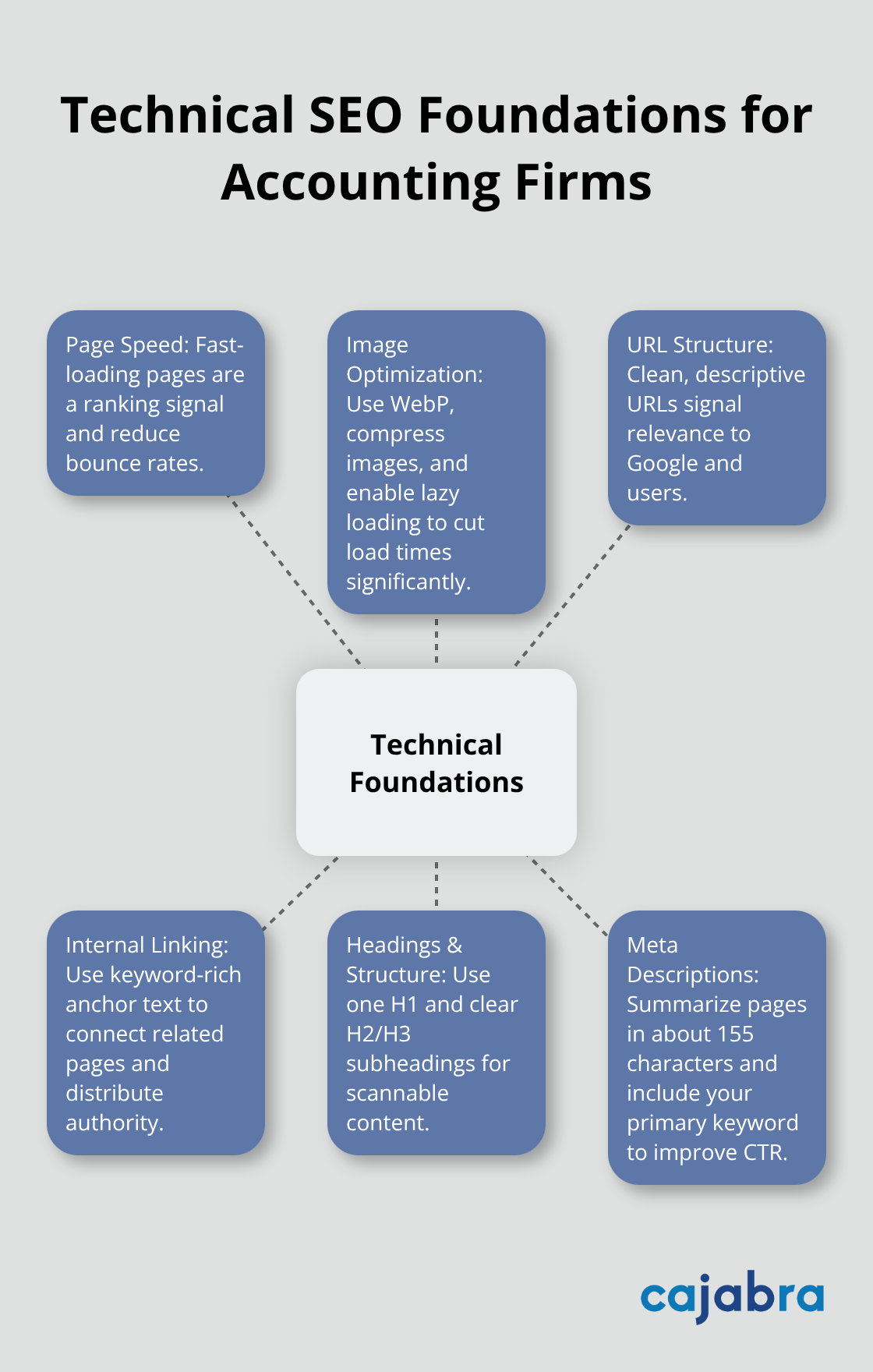
Page speed matters enormously because Google uses it as a ranking signal. Test your current speed with Google PageSpeed Insights right now. If your site takes six seconds to load, you've already lost potential clients to competitors.
Image optimization alone typically cuts load time in half for accounting websites because most firms upload uncompressed photos directly onto their sites. Use WebP format instead of JPEG or PNG, compress ruthlessly with tools like TinyPNG, and enable lazy loading so images load only when visitors scroll to them. These changes cost nothing and take hours, not days.
Your URL structure matters more than it appears. Clean, descriptive URLs like yourfirm.com/tax-preparation-for-llcs outperform cryptic ones like yourfirm.com/?p=12847. Google reads URLs as ranking signals, and so do potential clients when they see the link in search results.
Descriptive URLs also help with internal linking strategy, which helps search engines understand your site structure, distribute authority across pages, and improve indexing speed. When you write a blog post about quarterly tax planning for realtors, link to it from your realtor tax services page using anchor text that includes your target keyword. This internal linking tells Google which pages matter most and distributes ranking authority throughout your site strategically.
Content that ranks solves specific problems your prospects actually search for. High-intent keywords like tax preparation for S-corp owners or bookkeeping services for contractors pull in visitors ready to hire, while generic content about accounting basics attracts browsers who disappear without converting.
Use Google Keyword Planner to find monthly search volumes for specific keywords in your area, then try those with 500 plus monthly searches and medium difficulty ratings. A post targeting tax deductions for real estate investors might capture 200 to 400 qualified leads annually if it ranks on page one, compared to maybe 20 leads from a generic post about tax deductions.
Write content that directly answers the questions your prospects type into Google. If people search for how to file back taxes as an LLC, that exact question should appear in your first paragraph, not buried three sections deep. Structure matters for both Google and humans. Use one clear H1 heading per page that includes your primary keyword, then H2 and H3 subheadings that break content into scannable sections. Accounting content especially benefits from this structure because clients skim before reading deeply.
Meta descriptions should summarize your page in 155 characters and include your target keyword naturally, because this text appears in search results and influences click-through rates directly. These technical foundations work together to signal to Google that your site deserves ranking authority, but they only matter if your content actually speaks to what your prospects need. The next section shows you how to identify those prospects and build a local SEO strategy that puts your firm directly in front of them.
Google Business Profile optimization is non-negotiable if you want local clients to find you. Claim your profile immediately if you haven't already, then complete every single field available. Most accounting firms skip this step or fill it out halfway, which tanks their visibility in local search results and Google Maps. Your profile should include your full service list, hours of operation, phone number, website URL, and a professional photo of your office or team. Google treats a fully completed profile as a trust signal, and incomplete profiles rank significantly lower for local queries.
Once your profile is live, upload photos regularly. Firms that post new images at least monthly see higher engagement and click-through rates from local search results than those that don't update their profiles. Add images of your team, office space, and client testimonials to humanize your firm and build confidence in potential clients searching for an accountant in their area.
Citations matter far more than most accounting firms realize. A citation is simply your business name, address, and phone number listed on directories and websites around the web. Google uses citations to verify your business legitimacy and location, so consistency across directories directly impacts your local ranking position. Inconsistent information across directories actually damages your local SEO performance because Google sees conflicting data and downgrades your trustworthiness.
Start with high-authority accounting directories like the American Institute of Certified Public Accountants directory and state CPA association listings. Then add your firm to local directories like Chamber of Commerce websites, Yelp, and Better Business Bureau. Tools like Semrush Local Business Data or Bright Local can audit your current citations and identify where your information is missing or contradictory.
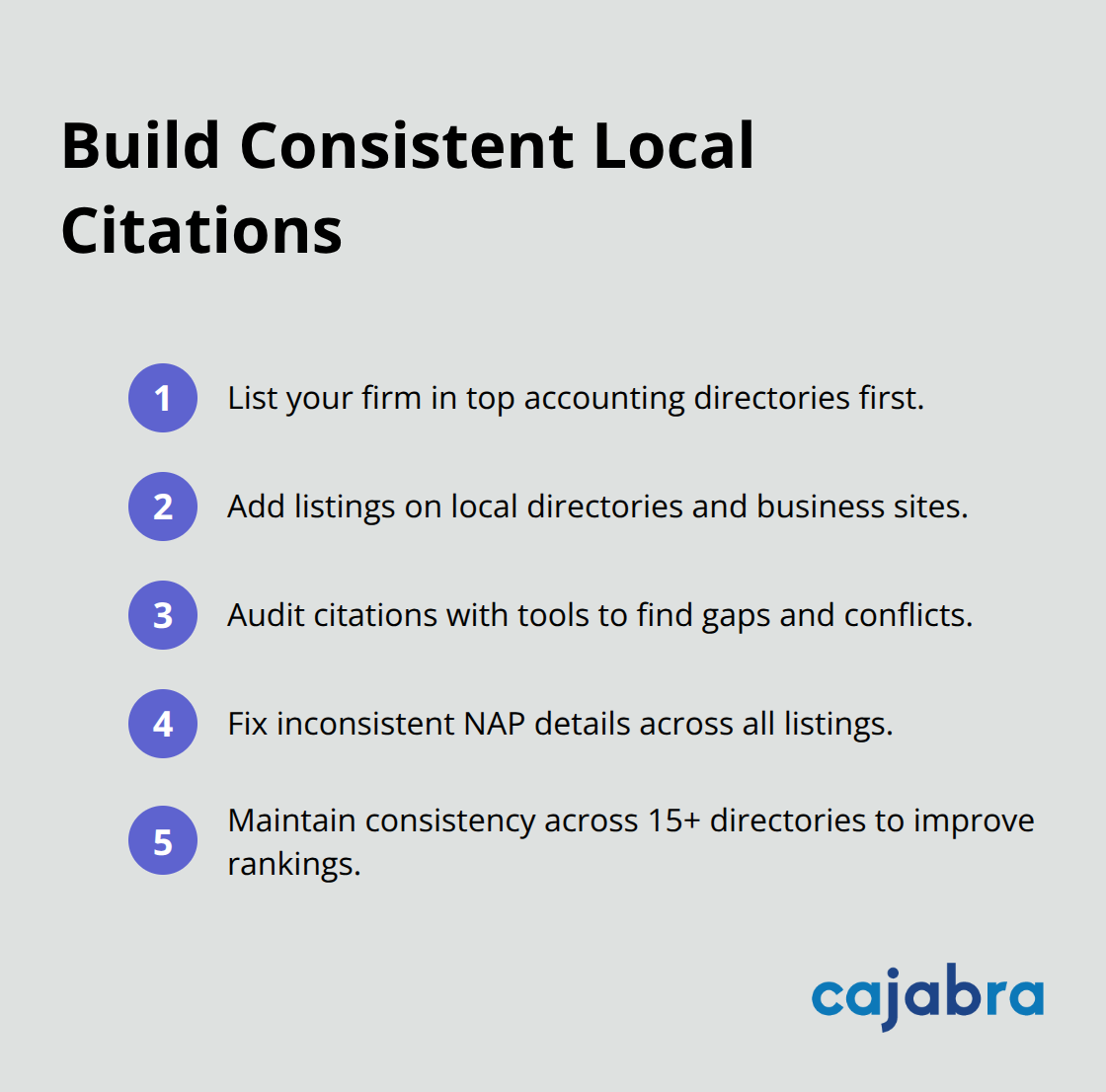
Fix these inconsistencies immediately because they directly suppress your local rankings. Firms that maintain consistent NAP information across 15 plus directories typically outrank competitors for local search terms.
Google uses reviews as a trust signal. A steady stream of real reviews helps your profile stand out in local search results and builds confidence with potential clients before they contact you.
Request reviews actively from clients after you complete their work. Send a follow-up email with a direct link to your Google review page rather than asking clients to search for your firm and find the review section themselves. The easier you make the process, the more reviews you'll receive. Respond to every review, both positive and negative. Responding to negative reviews shows prospective clients that you care about feedback and take client concerns seriously. A thoughtful response to a critical review often converts that negative review into a trust-building opportunity rather than a liability.
SEO for accountants transforms how firms acquire clients, and the accounting practices winning right now execute consistently on the basics rather than chase complex tactics. A single blog post targeting high-intent keywords like tax deductions for real estate investors generates 200 to 400 qualified leads annually once it ranks, while your fully optimized Google Business Profile directly influences whether local prospects contact you or your competitor. Reviews compound your credibility with every new client who leaves feedback, and these foundational elements cost almost nothing to implement.
Start with one high-intent keyword in your niche, write a thorough post answering the exact question prospects search for, optimize it technically, and observe the results. Then repeat this process consistently, building a steady stream of inbound leads that require far less sales effort than cold outreach. The firms that commit to SEO for accountants stop chasing leads and start selecting which clients to accept.
Your firm can implement these exact strategies and watch your client acquisition transform. Pick one keyword this week, publish one post next week, and let the compounding effect of consistent effort build your visibility over the next three to six months.