

Accounting firms that publish content alone waste time and miss opportunities. When your team collaborates on content creation, you catch errors faster, maintain consistent messaging, and build stronger client relationships.
At Cajabra, LLC, we've seen firsthand how content collaboration transforms firms from scattered publishers into coordinated marketing machines. This guide shows you exactly how to make it work.
Client trust in accounting firms hinges on consistency and expertise. When your content comes from fragmented sources-one partner writing tax tips, another handling compliance updates, a third managing social posts-clients notice the disconnect. They hear conflicting advice, spot outdated information, and question whether your firm operates as a cohesive unit. Collaborative content creation eliminates this problem. When your team aligns on messaging, clients see a unified voice backed by coordinated expertise.
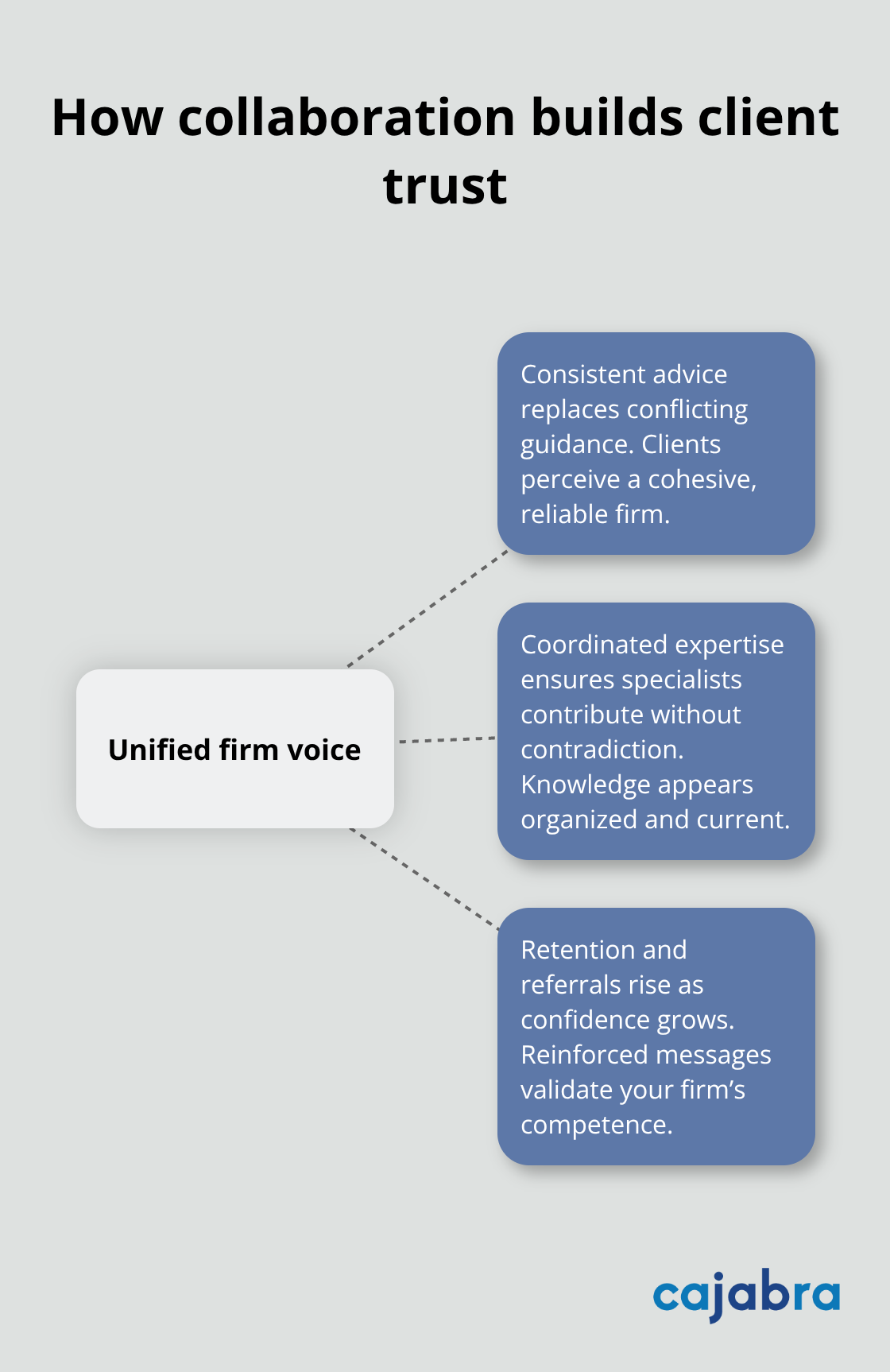
Organizations with aligned internal communication achieve stronger business outcomes through coordinated strategy and leadership. For accounting firms, this translates directly into client retention and referral rates. A client who reads a blog post about tax strategy, then receives an email from your team reinforcing that exact strategy, develops confidence that your firm knows what it's doing. That confidence converts into retainer agreements and referrals to their networks.
Publishing content quickly gives accounting firms a competitive edge in capturing client attention during tax season, regulatory changes, or market shifts. When one person writes content in isolation, the timeline stretches-drafts sit in inboxes, feedback arrives piecemeal, revisions pile up. Collaborative workflows compress this cycle dramatically. Tools like Google Docs enable real-time editing where multiple team members add expertise simultaneously, reducing the time from concept to publication from weeks to days. Firms that publish weekly outpace those that publish monthly by a factor of three in lead generation. The speed advantage matters because clients searching for answers about new tax laws or compliance requirements expect current information. A blog post published three weeks after a regulatory change has minimal impact; one published within days captures the search traffic and establishes your firm as responsive and informed.
Coordinating your content calendar across team members prevents duplicate work and ensures someone owns each publishing deadline. When responsibilities are clear, deadlines get met. Without this structure, content projects stall indefinitely. Your team members juggle competing priorities, and no single person feels accountable for completion. Collaborative systems (like project management tools that track progress and flag overdue tasks) create visibility across the firm. Everyone knows what's due, who's responsible, and what stage each piece occupies. This transparency eliminates the back-and-forth emails and status-check meetings that waste time. Your team moves faster because they work toward shared deadlines, not individual agendas.
Accounting firms lose institutional knowledge constantly. A senior tax specialist leaves, and suddenly no one remembers the nuances of handling S-corp elections for your client base. Collaborative content creation forces your team to document expertise in written form before it disappears. When your team member who specializes in nonprofit accounting writes a guide on Form 990 requirements, that knowledge becomes accessible to junior staff, new hires, and future clients. This knowledge transfer improves service delivery because newer team members can reference written frameworks instead of relying on informal mentoring. It also protects your firm against key-person dependency. If your top performer leaves, your clients don't leave with them because your content demonstrates that expertise lives throughout your organization, not in one person's head. This institutional knowledge becomes a competitive asset that strengthens your firm's market position.
As your team collaborates on content, something shifts. Junior accountants learn from senior partners through the writing process. Partners discover gaps in their own knowledge when they try to explain concepts clearly. The firm's collective expertise surfaces and strengthens. Each piece of content your team creates becomes a reference point for future projects, reducing the time needed to tackle similar topics. Your team builds a library of frameworks, case studies, and explanations that accelerate future content production. This compounding effect means your second year of collaborative content creation moves faster than your first, and your third year faster still. The investment in collaboration systems pays dividends that multiply over time.
Now that your team understands why collaboration matters, the next step is establishing the structures that make it work. Clear roles, defined processes, and the right tools transform good intentions into consistent output.
Collaboration fails when accountability disappears. Your team needs crystal-clear ownership of each piece of content, from research through publication. Assign one person as the content owner for each project-they drive the piece forward, coordinate feedback, and hit the deadline. This person isn't necessarily the writer; they're the project lead who ensures nothing stalls.
Alongside the owner, identify specific roles: who researches, who writes the first draft, who reviews for accuracy, who handles final edits, and who publishes. Document these roles in your project management system so everyone sees who does what. Without this clarity, three people end up writing the same section while another piece sits forgotten. Firms waste months on content projects simply because no one person felt responsible for completion.
Your team members have competing client demands, and content only moves forward when someone owns it completely. Once roles are assigned, your deadlines become achievable because accountability is personal, not collective.
Google Docs works well for real-time collaboration, but you need a system layered on top that tracks who owns what and when it's due. Tools like Karbon centralize work, tasks, and comments in one place, eliminating the email chains that slow projects down.
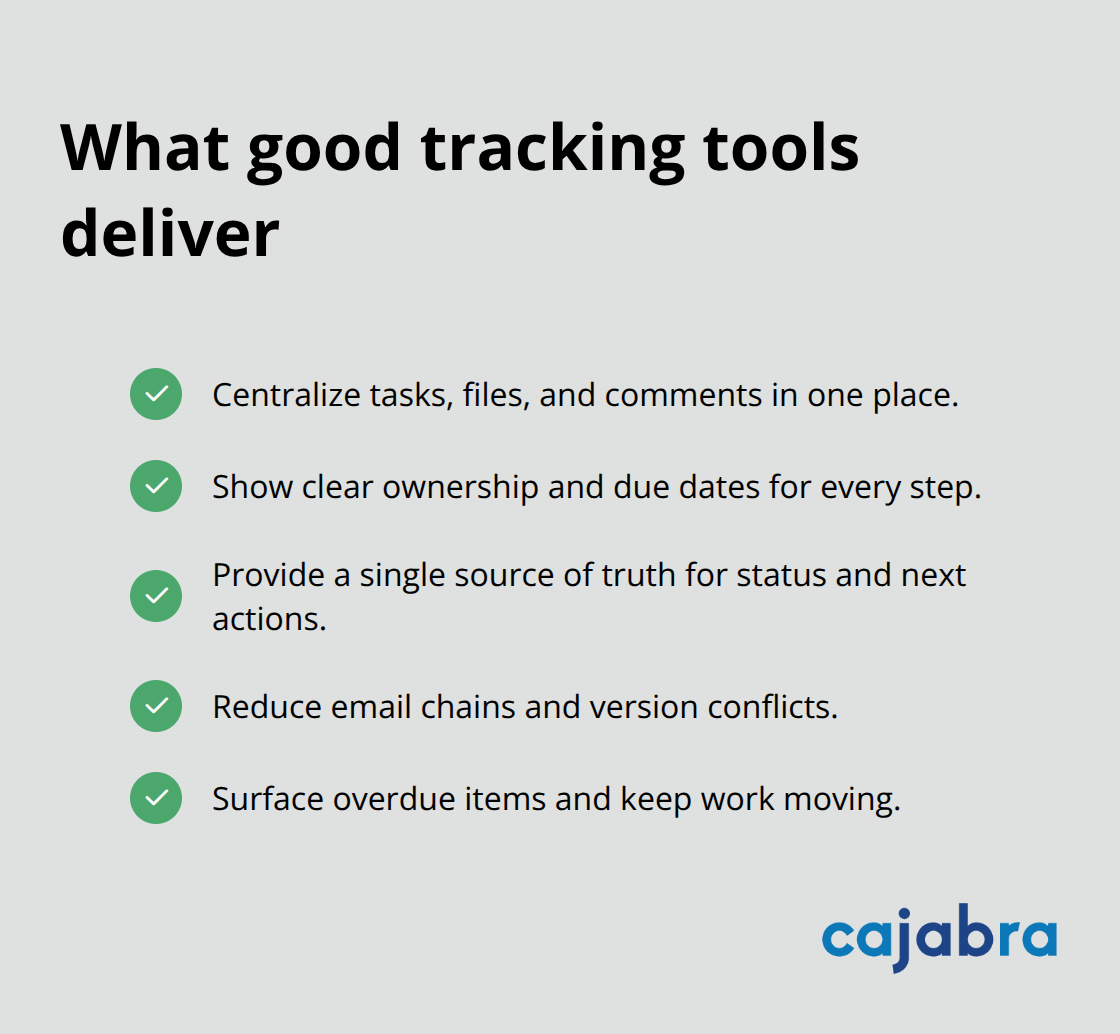
These tools prevent content from falling through cracks because everyone sees the same timeline and knows their specific responsibility. Your team members no longer wonder whether someone else is handling a task-the system shows exactly who owns what and what stage each project occupies. This transparency eliminates the back-and-forth emails and status-check meetings that waste time.
Your content needs a voice, and that voice must sound consistent whether a partner or junior accountant writes the piece. Create a one-page brand guide covering tone, vocabulary, formatting, and messaging priorities. State explicitly whether you use technical jargon or plain language, whether posts are formal or conversational, and how you handle citations. Include three sample paragraphs showing the tone you want.
Firms that skip this step publish content that feels disjointed-one article reads academic, the next sounds like a sales pitch. Your clients notice the inconsistency immediately. A centralized content library prevents duplication and helps new writers understand your style quickly. SmartVault or similar secure platforms work well for accounting firms because they combine document storage with version control, so your team always works from the current version.
Define your editorial calendar at least three months out, assigning topics to owners and marking key deadlines. Tax season demands different content than slow periods, and planning ahead prevents scrambling. Most accounting firms publish monthly or less; firms publishing weekly generate three times more leads.
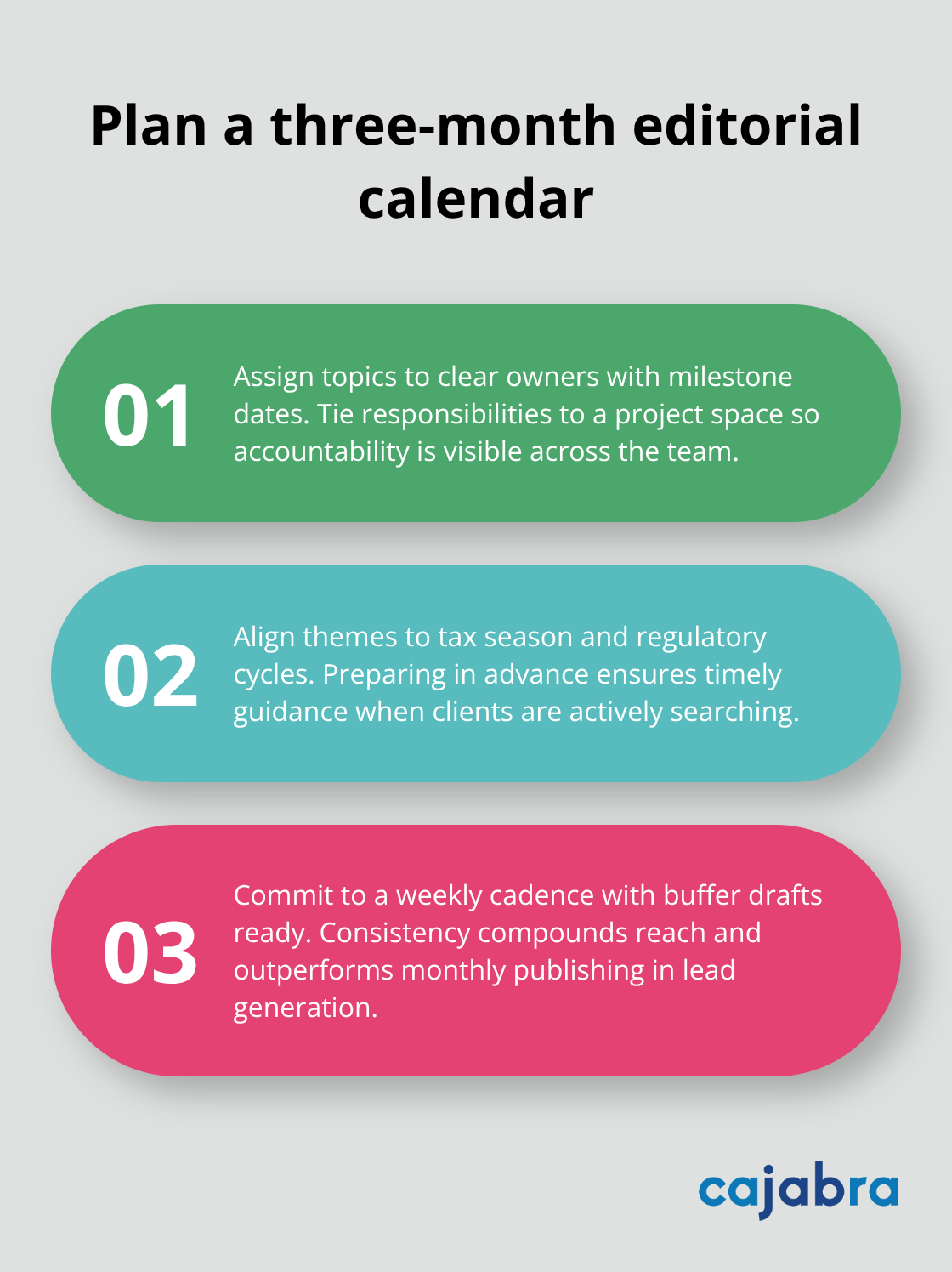
Weekly publishing requires planning and structure, not genius. Your team publishes consistently when deadlines are known, roles are clear, and the right tools eliminate friction between writing and publishing. This foundation transforms content from an occasional project into a reliable revenue driver.
With your internal structure in place, the next step is ensuring your content actually reaches the clients who need it most-which means understanding where your audience searches for answers and how to position your firm as the obvious choice.
Most accounting firms fail at content collaboration not because they lack good intentions, but because they skip the unglamorous work of defining who does what and when. The result is predictable: team members publish contradictory tax advice, deadlines slip indefinitely, and departments operate in isolation.
One partner posts on LinkedIn about aggressive tax strategies while another publishes a blog emphasizing conservative compliance approaches. Clients read both and question whether your firm has a coherent philosophy. Inconsistent messaging destroys client trust and erodes credibility across your firm's communications.
The problem compounds because no single person owns the content calendar. Your tax team assumes marketing is handling the editorial plan. Marketing assumes the partners will submit guest posts. Weeks pass, nothing gets published, and everyone blames the others. Without explicit ownership and accountability, your team treats content as a part-time side project that loses to urgent client work every single time.
Communication fractures across departments because email chains replace centralized project tracking. Your tax specialist sends feedback to the marketing manager, who forwards it to the writer, who replies to someone else entirely. Three versions of the same document circulate simultaneously. Your team wastes hours merging edits and resolving version conflicts instead of creating better content.
Firms that implement centralized project management platforms eliminate collaboration chaos by keeping track of every detail and showing exactly who owns what and where each project stands in the pipeline. Everyone sees the same timeline, knows exactly who owns each task, and avoids the email loop that strangles productivity.
Your senior tax partner writes in dense, technical language. Your junior accountant writes conversationally for small business owners. Your marketing person writes like a sales pitch. Clients notice the whiplash instantly and question whether these pieces actually come from the same firm.
A one-page brand guide stating your tone, vocabulary choices, and messaging priorities solves this completely. It takes ninety minutes to write but prevents months of inconsistent output. Firms that establish this guide see higher engagement because readers experience a coherent firm voice across all content. Include three sample paragraphs showing the tone you want, so new writers understand your style quickly.
Your team scrambles to publish something every month because no one planned ahead. You miss timely opportunities during tax season when clients actually search for answers. You publish content that overlaps with pieces from three months ago because nobody tracked what's already published.
A three-month editorial calendar prevents this entirely. Assign topics to owners, mark deadlines, and watch your team publish with rhythm instead of chaos. Firms publishing weekly generate three times more leads than monthly publishers because consistency signals authority and captures search traffic during peak demand periods. Tax season demands different content than slow periods, and planning ahead prevents scrambling when client work intensifies.
Content collaboration transforms accounting firms from scattered publishers into coordinated revenue generators. The firms winning new clients publish consistent, timely content that demonstrates expertise across their entire team, not just isolated experts. When your tax specialist, compliance officer, and junior accountant all contribute to your firm's content, clients see depth and perceive a unified organization that converts into retainer agreements and referrals.
The mechanics require four straightforward steps. Assign clear ownership to each content project so someone drives it forward, use project management tools that track progress and eliminate email chains, establish a one-page brand guide so your voice stays consistent across writers, and plan your editorial calendar three months ahead so you publish with rhythm instead of scrambling. Firms publishing weekly generate three times more leads than monthly publishers because consistency signals authority and captures search traffic during peak demand periods.
We at Cajabra, LLC help accounting firms build the marketing systems that turn content into consistent client acquisition through strategic positioning and lead generation. Explore how Cajabra can help your firm transform content collaboration from occasional projects into a reliable revenue driver.